
Article by Burkhard Berger
Social Listening: How to Turn Online Conversations Into Customers
Apr 17 • 25 min read
What Is Social Listening?
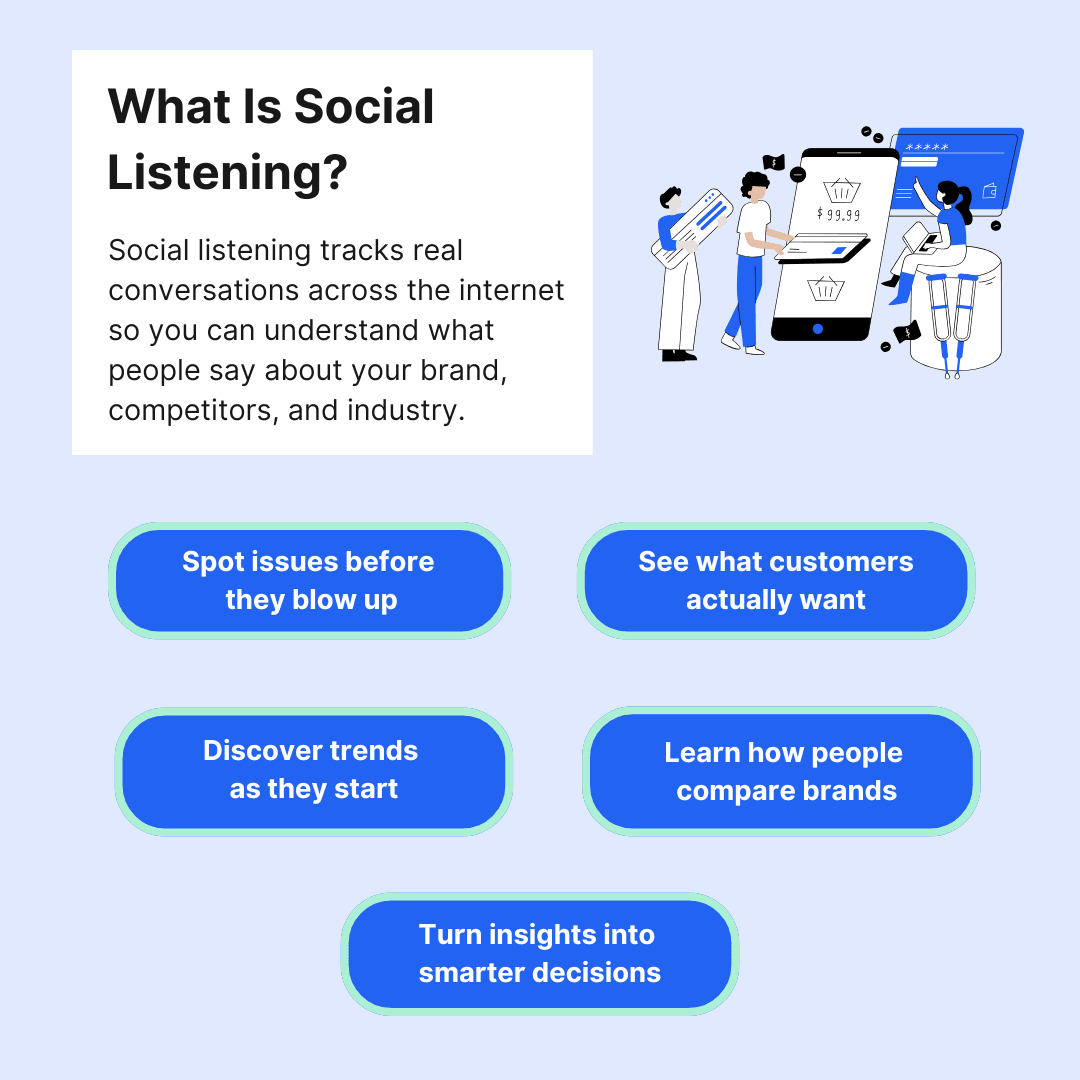
Social listening is the practice of actively tracking and analyzing conversations happening online about your brand, industry, competitors, or relevant topics. You interpret the context and sentiment behind those conversations to understand how people feel and what they care about.
Through social listening, you can:
- Spot patterns in customer feedback
- Identify emerging issues before they escalate
- Uncover opportunities for engagement
- Make decisions based on valuable insights
Social listening sits deeper than social media management because it tells you why conversations happen, not just how to post more often on social media accounts.
Social Listening vs Social Monitoring: Understanding The Major Differences
People often lump these two together, but they do very different jobs. Before you build anything serious, lets understand the differences between social monitoring and social listening.
Why Social Listening Is Important For Your Business: 6 Key Benefits
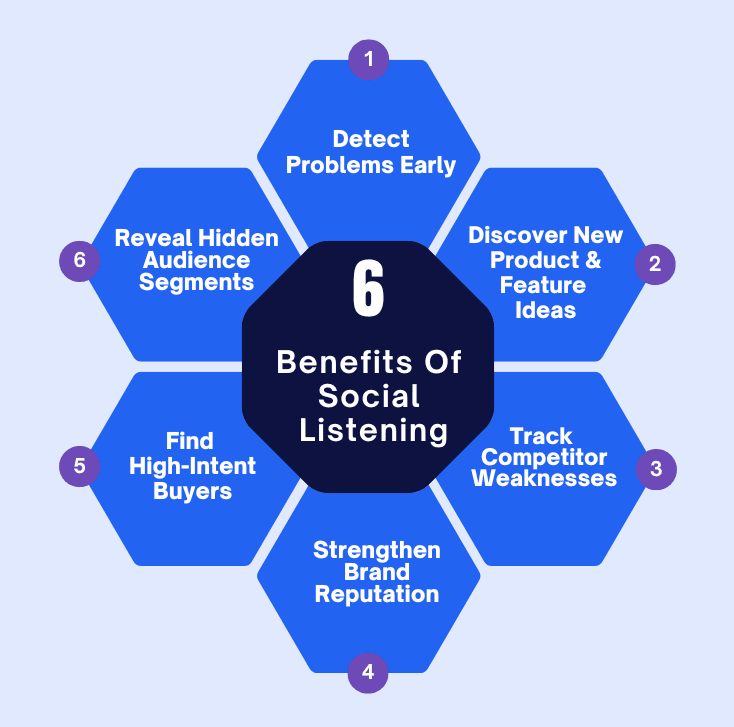
When you look at different social listening examples across industries, one thing stands out the advantage always comes from understanding customer conversations earlier than everyone else. Here are 6 benefits that show exactly why it deserves a permanent place in your social media strategy.
1. Detect Problems Early Before They Turn Into PR Disasters
Social listening gives you the kind of visibility your inbox never shows you.
You start seeing cracks way before anybody starts shouting. Someone is annoyed about a new update. Someone thinks your pricing page is misleading. Someone says your product suddenly got buggy.
You are aware of the mood around your brand long before influencers or angry threads start piling up. This helps with crisis management because the story doesnt get away from you. You know what people are saying and why it started in the first place.
PR chaos becomes rare because nothing escalates quietly behind your back.
Real-World Example: Re Cost Seg
When Re Cost Seg published a study about land value vs improvement value in cost segregation, they started noticing a pattern in LinkedIn comments and small Reddit threads where property investors were confused about it.
Nobody was tagging the company directly. The posts werent angry. They were hesitant. People were sharing screenshots of spreadsheets and saying things like this part feels unclear or I dont know if Im calculating this right.
Because social listening picked this up early, Re Cost Seg didnt wait for angry blog posts or avoid this firm threads. Instead, they:
- Published a short clarification article
- Updated one confusing paragraph on their site
- Gave support reps a simple script for explaining it
- Recorded a quick walkthrough video for new clients
The issue stayed small because it was handled before frustration had time to grow teeth.
2. Discover New Product & Feature Ideas
People set your brands direction for you and they do it publicly.
They talk about workarounds they use. They compare you with tools that do one small thing better. They explain what would have saved them two hours if your product did it.
And that is the real benefit you get.
You are not sitting in meetings arguing about what users probably want. You identify trends and watch real people explain things in simple language. The ideas are sharper. The decisions are faster. And updates go over better because the need already exists, and everyone recognizes it instantly.
Real-World Example: Custom Sock Lab
Custom Sock Lab watched conversations anywhere people talk merch: Reddit threads. Shopify groups. Small business Slack communities. They started noticing something super specific.
Small businesses wanted smaller minimum order quantities for custom socks especially for pop-ups, fundraisers, and micro-brands. People complained about other vendors forcing huge commitments. And nobody suggested Custom Sock Lab directly. They simply described the frustration.
So Custom Sock Lab treated that as product guidance. They introduced:
- A micro-batch program
- Faster turnaround for small runs
- Simple pricing on the product page, instead of quote-only
Suddenly, those same conversations shifted. The people started mentioning that if you just needed 50 or 100 pairs, Custom Sock Lab is the one to check. The feature didnt come from brainstorming. It came straight from online conversations customers were already having.
3. Track Competitor Weaknesses & Position Your Brand More Clearly
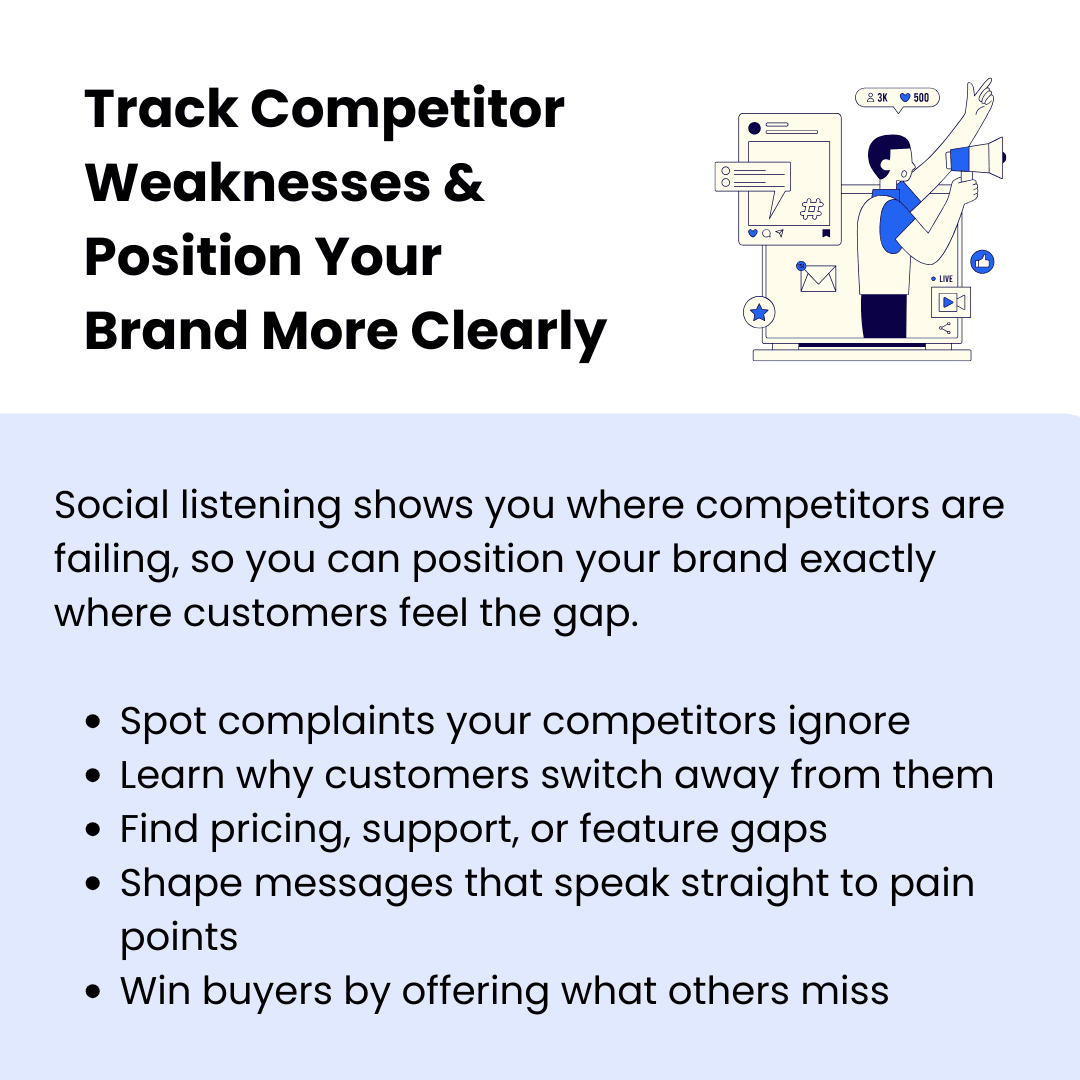
Social listening lets you see the parts of your competitors they would never put on their homepages.
Customers complain about onboarding that drags on forever. They talk about hidden fees. They mention slow dashboards and broken integrations. They describe why they switched and what pushed them over the edge.
The benefit is strategic you position your brand where they cant.
You know where they are soft. And this competitive analysis gives you room to claim territory with confidence, rather than shouting the same generic selling points as everyone else.
Real-World Example: GetSafe
GetSafe picked up repeated complaints about competitors that focused on one thing: confusing policy language and slow onboarding. Customers shared screenshots of long forms and complained about unclear coverage terms in comment threads and review replies.
Instead of advertising best medical alert system! like everyone else, GetSafe shifted its positioning. They highlighted:
- No long contracts
- Simple setup without tools
- Honest pricing
- Modern, wireless devices
And they explained it clearly in plain language.
Now, when families research options, GetSafe sits in the exact gap competitors keep leaving open because they are using insights those competitors completely ignore.
4. Strengthen Brand Reputation By Responding Where Conversations Happen
A lot of brand talk happens without mentions or tags.
Someone vents in a thread. Someone shares a half-correct rumor. And nobody expects the brand to notice because most brands dont.
Social listening helps your reputation grow in places marketing budgets never reach. And when people see that consistency, it helps grow your business because they see a company that shows up, clears the air, owns mistakes, and explains things like a human.
Over time, it shapes a stronger social media presence. Your name starts carrying weight, not because you polished it, but because people watched you behave consistently. That kind of reputation management lasts.
Real-World Example: Start In Wyoming
Start in Wyoming saw founders discussing virtual offices in small business forums and Twitter threads. Some comments mixed correct information with half-truths about compliance and mail handling. No one expected a response.
Rather than ignoring it, Start in Wyoming joined the conversation calmly. They explained:
- How compliance actually works
- What is legitimate vs what isnt
- How they handle documentation and transparency
- Step-by-step onboarding clarity
They didnt push a sale. They educated. And the people in the thread watched that interaction unfold. Suddenly, the narrative shifted from uncertainty to These guys actually know what they are doing.
Over time, more founders reached out not because of ads but because they saw how the brand shows up in public conversations. That is the reputation built in real time.
5. Find High-Intent Buyers & Create Context-Driven Sales Opportunities
Inside everyday social media conversations are people who are basically saying, Im ready to buy, I just want the right option.
They talk about switching tools. They compare brands by specific use cases. That is pure buying intent, and social listening lets you discover demand that already exists.
No pushing people who arent interested. You show up around discussions where a decision is already underway which makes every conversation warmer and far more likely to convert.
Real-World Example: John, The Hilton Head Property Advisor
John, the Hilton Head property advisor, noticed social media posts where people casually mentioned relocating to Hilton Head and compared neighborhoods based on schools, rental potential, or walkability. These were people already deciding.
So John listened to conversations in Facebook local groups and Reddit threads about coastal living. He wasnt blasting listings everywhere. He was watching for intent. And instead of dropping a generic sales pitch, John jumped in with context:
- Explained neighborhoods that fit
- Dropped a quick pros/cons breakdown
- Offered a simple free call, zero pressure
He showed that he understood the exact scenario being discussed second homes, lifestyle shifts, retirement transitions.
Because the conversation already contained buying intent, his outreach didnt feel random. People were guided, and that is what converts.
6. Reveal Hidden Audience Segments You Arent Actively Targeting
Social listening quietly surfaces whole groups of people who already care about the problem you solve but never appear in your marketing lists or persona documents. They do not introduce themselves as a target market.
They simply talk about daily routines and frustrations in public threads. When you read those conversations, you start seeing patterns that never show up in dashboards shared schedules, shared triggers, shared situations.
This benefit is very practical. You suddenly see clusters that form around context instead of demographics. People connect through shift work, exam seasons, travel patterns, caregiving roles, or long computer days. These conversations reveal audiences you never built campaigns for, yet they sit inches away from your brand and already use language that aligns with it.
Real-World Example: Brain Ritual
Brain Ritual deals in nutritional supplements for migraine support. Through social listening, they began to notice conversations coming from unexpected pockets of people who still talked about migraine cycles frequently.
They saw:
- Pilots and cabin crew discussing migraines tied to rapid time zone changes
- Teachers mentioning classroom noise and lighting as headache triggers
- New parents connecting sleep disruption with migraine frequency
These groups were not part of their original core audience plans. They appeared through organic conversations on Reddit threads and migraine Facebook groups. People described in detail, and Brain Ritual could clearly see distinct audience segments forming in public conversations.
The benefit was simple and powerful social listening revealed real communities already dealing with the problem, and that insight only appears when you listen where real conversations already happen.
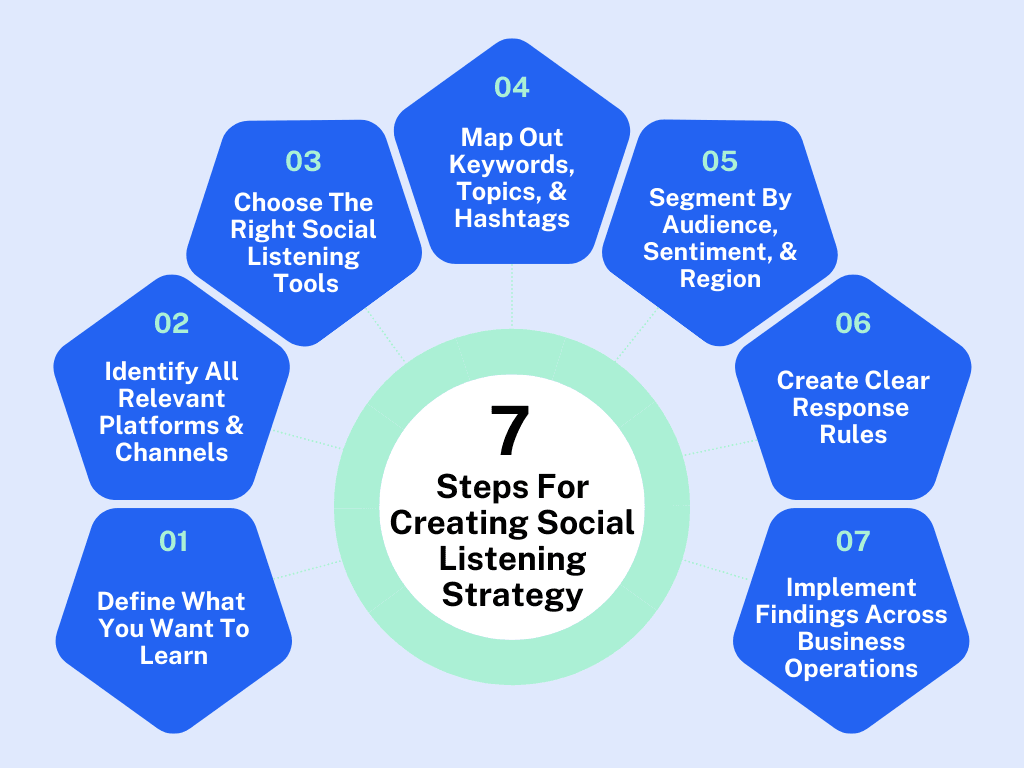
How To Create A Social Listening Strategy For Your Brand
Up to now, it has been about why social listening matters. From here on, it is about how you put structure around it and make it usable day to day. Let's break down how to set up social listening so it works for your brand, not in theory, but in real use.
1. Define What You Want To Learn From Social Media Listening
Social listening only works when you walk in with intent. Random monitoring turns into endless tabs and half-read alerts fast. You need to decide the type of knowledge that moves you forward. That decision sets everything else, from keywords to tools to reporting.
Start by tying learning goals directly to real business decisions. Growth teams listen for buying signals. Product teams listen for friction and requests. Brand teams listen for perception shifts. Each goal produces a completely different listening setup.
What to Do:
- Write one statement per goal using this format: We want to understand ______ so we can ______.
Create separate objectives for:
- Product
- Marketing
- Support
-
Leadership
- Decide what useful means for each team complaints, praises, objections, buying intent, rumors, misinformation, etc.
- Set time windows: Daily monitoring, Weekly themes, Monthly patterns.
- Decide what you are ignoring on purpose so attention stays disciplined.
2. Identify All Relevant Platforms & Channels
Your audience spends an average of 147 minutes daily on social media, and they have already picked where they talk. Your job is to meet them there instead of forcing attention into major social media platforms. Each channel serves a different purpose and conversation style, and treating them the same creates blind spots.
Reddit exposes unfiltered opinions. X shows real-time reactions. LinkedIn reveals professional priorities. Review sites highlight purchase-stage thinking. Coverage matters more than volume.
What to Do:
List every place your target audience spends time, including:
- Reddit communities
- Niche Facebook groups
- TikTok comment sections
- X threads
- LinkedIn posts (not just your own)
- Industry forums
- Review sites (G2, Trustpilot, App Store, Play Store)
-
Private spaces where people talk publicly about (Slack communities, Discord servers)
Separate platforms by conversation type:
- Short reactions
- Long discussions
- Complaints
- Comparisons
-
Tutorials/user experiences
- Identify where competitors are mentioned repeatedly.
- Mark channels where tagging rarely happens because that is where brands miss most relevant social conversations.
Decide priority tiers:
- Tier 1: Daily monitoring
- Tier 2: Weekly check-ins
- Tier 3: Monthly deep dive
3. Choose The Right Social Listening Tools For Your Goals
Social media listening tools shape what you see and what you miss. Generic platforms usually overpromise and underdeliver. The right social media monitoring tool matches your learning goal rather than chasing every metric under the sun. Some advanced social listening tools map themes across months of conversation. Others excel at volume tracking.
The goal isnt random data collection. You need to gather information that actually changes decisions. Choosing the social listening platform correctly saves time and avoids shallow social listening insights. And yes, this goes beyond your own social media accounts, because most of the real talk happens elsewhere.
What to Do:
- Match tools to the goals you wrote earlier brand monitoring, competitor tracking, misinformation watching, review analysis, trend discovery. One goal per tool if needed.
Check whether the tool can track:
- Misspellings
- Nicknames
- Abbreviations
-
Product names vs brand names
- Make sure it supports your actual platforms (not just the big ones).
- Test reporting views. If it only dumps raw social listening data, it wastes time.
- Run a 24 week trial and compare tools on the same queries side by side.
- Decide which departments get access and who owns what dashboard.
4. Map Out Relevant Keywords, Topics, & Hashtags To Track
Tracking social chatter works only if you know what to look for. Randomly searching social media posts and brand mentions wont get you anywhere. You need a list of the exact phrases and hashtags your audience actually uses.
And no, this isnt just your brand name. Think competitors, products, trending phrases, industry lingo, and even slang your audience throws around.
What to Do:
Create separate keyword lists for each area:
- Brand: brand name, product names, abbreviations, old names, common typos
- Campaigns: slogans, hashtags, promo codes, partnership tags
- Industry: problem-based terms, jargon, phrases customers actually use
-
Competitors: competitor names, product lines, nicknames, misspellings
- Add problem words and action words around each keyword. Example templates: doesnt work, worth it, alternative, recommend
- Build separate hashtag lists: branded, community, event-based, problem-based.
- Remove vague words that trigger useless talk decide them deliberately.
- Review the list every 30 days and prune what creates confusion.
5. Segment Conversations By Audience, Sentiment, & Region
Not every mention matters equally. A gripe from a top influencer hits harder than a random retweet. Segmenting gives you clarity so you can act strategically, not react randomly. Audience type, tone, geography everything matters. You want to know who is talking and where they are.
What to Do:
- Create audience categories: customers, prospects, ex-customers, influencers, critics, partners, random commentators.
- Separate intent: questions, complaints, praise, comparisons, misinformation, curiosity.
- Track customer sentiment without guessing emotions use language cues and context patterns instead of assumptions.
- Tag geographic regions: country city when relevant, especially if operations differ.
- Mark conversation type: public thread, private message, review, forum discussion, comment reply.
- Build dashboards for each segment instead of one big mentions list.
6. Set Clear Rules For When & How Your Team Should Respond
Without response rules, teams either stay silent too long or jump into conversations they shouldnt touch. You need clear rules, so your team knows exactly what to do in every scenario.
What to Do:
- Build a simple response matrix: issue type owner timeframe response style.
- Define hard response windows urgent complaints, misinformation, positive mentions, product questions.
- Create approved response templates as starting points then personalize them each time.
- List situations where the brand never engages (trolls, abuse, bait threads, harassment).
- Define escalation paths: support legal PR leadership with triggers for each.
- Decide what must always move to DM and what must always stay public.
7. Implement Findings Into Marketing, Sales, & Product Decisions
Listening only matters if it changes what you do. Every insight should help with decisions that touch the customer social media marketing campaigns, product updates, or sales outreach. Insights like these slowly reshape your entire marketing strategy because they come straight from real conversations. The best brands turn relevant conversations into measurable action.
What to Do:
- Create monthly meaningful insight roundups broken into relevant teams: marketing insights, sales insights, product insights, support insights.
- Turn recurring complaints into documented fixes, not just replies.
- Rewrite landing page copy using exact customer phrases pulled from conversations.
- Hand sales teams the real objections users mention with clear counterpoints.
- Turn repeated product requests into backlog tickets with examples attached.
- Track outcomes: what changed inside the business because of one insight.
Conclusion
Social listening rewards patience and focus. It is not flashy, but it gives you something flashier: clarity. So, listen closely, act intentionally, and integrate what you learn into every corner of your business. The conversations are happening whether you are watching or not. Make sure you are watching.
We have been talking about social listening the whole way through because understanding what people are saying online gives you a real edge. We built ShortDot with the same mindset - clarity, purpose, and being seen exactly the way you want to be seen online.
At ShortDot, we operate some of the worlds most memorable domain extensions like .bond, .icu, .cyou, and more, and we make it simple for creators and entrepreneurs to carve out a unique space on the internet that actually matches their brand identity.
Get yours now and stake your claim with a domain that actually says something about who you are and what you stand for.